

The majority of antidepressant medications mentioned in this article have a boxed warning, the most serious type of warning from the Food and Drug Administration (FDA). They pose a risk of suicidal thoughts and behaviors. Remember to discuss the risks and keep in touch with your healthcare provider during the whole course of treatment.
Highlights
- Antidepressants are available only by prescription. They may be recommended alongside cognitive-behavioral therapy also known as talk therapy.
- Getting prescribed antidepressants involves consulting a medical provider to determine a suitable course of treatment.
- Psychiatrists, licensed clinicians, nurse practitioners, and physician assistants may be able to prescribe antidepressants, depending on local laws and regulations.
- Different factors influence the decision to prescribe antidepressants, such as the duration and severity of symptoms, health history, etc.
Antidepressants are only available by prescription. They have both benefits and side effects, and different people may respond differently to the same medicine. Therefore, it is important to consult with a healthcare provider to determine the best course of action.
Read on to find out when antidepressant medications may be considered and what steps are involved in getting antidepressants prescribed, when needed.
How to Get Prescribed Antidepressants
When a person with depression feels insignificant change from therapy or other non-medication treatments, a healthcare provider may recommend antidepressants. The choice of treatment depends on various factors such as the severity of symptoms, medical history, and the patient’s needs. So, the first step to getting a prescription for antidepressants is to consult a health professional. Here is what’s involved in the process:
- Schedule an Appointment. Sign up on the platform and fill out the basic forms. Choose the date and time for your initial appointment.
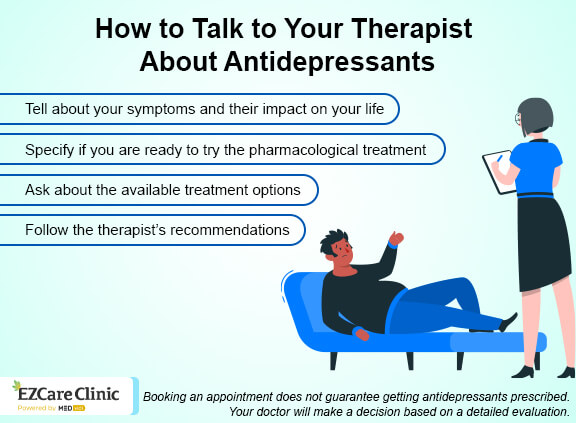
- Discuss Your Symptoms. A healthcare provider will evaluate your symptoms, their effect on your life, medical history, and any other relevant factors to determine if antidepressants are an appropriate treatment option for you. It’s important to be open and honest about your experience and any efforts you made to manage the symptoms. It could be beneficial to list your symptoms and any questions you have before the visit.
- Receive a Treatment Plan. Your healthcare provider may recommend various treatment options, including antidepressants, therapy, lifestyle changes, or a combination of these approaches. At this point, you can tell if you think you may benefit from antidepressant medication. However, note that the final decision is at the discretion of your clinician. If they determine that antidepressants are appropriate for your condition, they will write a prescription, send it to your pharmacy of choice, and discuss the potential benefits and risks.
- Attend Follow-ups. If you get prescribed antidepressants, follow your clinician’s instructions carefully. Remember to regularly attend follow-up appointments so that your healthcare provider can monitor your response to treatment and adjust it as needed.
Who Can Prescribe Antidepressants
In most cases, antidepressant medications can be prescribed by any of the following healthcare professionals:
- Psychiatrists. These are medical professionals with expertise in diagnosing and treating mental health conditions, such as depression, anxiety disorders, and others. They have the legal right to write prescriptions and provide psychotherapy.
- Primary Care Physicians. These medical professionals offer primary care and treatment for various health issues, including mental health conditions. If necessary, they can refer patients to mental health professionals and write prescriptions for antidepressants.
- Other Licensed Clinicians. Depending on local regulations, other medical doctors can also prescribe antidepressants when appropriate, including those providing care through telemedicine services.
- Nurse Practitioners. These are advanced practice nurses with additional education and training in identifying and managing mental health issues. Depending on their scope of practice, they might prescribe antidepressants.
- Physician Assistants. These are healthcare professionals who can perform duties including conducting health assessments, diagnosing and treating medical conditions, interpreting diagnostic tests, and prescribing medications. They can prescribe antidepressants in collaboration or under the supervision of a licensed physician.
Can Medical Providers Prescribe Depression Medication Online?
Yes, doctors and some other medical providers can prescribe antidepressants online through telemedicine services according to certain regulations and rules. In general, online prescribing of antidepressants may require the following:
- An Online Consultation. To get an antidepressant prescription in person or online, you’ll need to see a medical professional first. After carefully evaluating and diagnosing your condition, your healthcare provider will determine a suitable course of treatment for you, which can include specific antidepressant medicines. You will also be able to request prescription refills during online consultations.
- Access to Medical Records. An online doctor or another licensed medical provider working via telemedicine may need access to your medical records to evaluate your condition and determine if medication for depression is an appropriate treatment option.
- Compliance With Regulations. Healthcare providers who prescribe medications online should follow professional guidelines like those offering in-person care, as well as comply with additional telemedicine regulations.
Can You Get Prescribed Antidepressants Without Seeing a Doctor?
You can’t start taking antidepressants without consulting a mental health professional or another licensed medical provider. Antidepressants are prescription medications that require careful monitoring and management by a medical professional because they can cause side effects and can interact with other medications. During the course of treatment, they will monitor your health dynamics and adjust your medication regimen to ensure the safety and effectiveness of treatment.
Types of Antidepressants
Antidepressants are medications commonly used to treat depression, anxiety disorders, and other mental health conditions. They work by affecting the levels of certain chemicals in the brain, such as serotonin, norepinephrine, and dopamine.
There are several
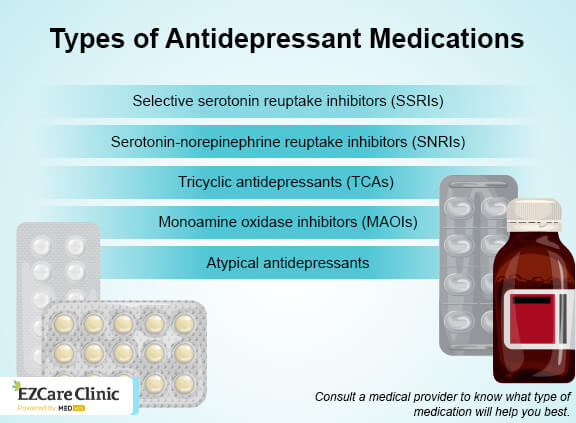
- Selective Serotonin Reuptake Inhibitors (SSRIs). They prevent serotonin from being reabsorbed in the brain, which causes an increase in serotonin levels. Serotonin is a neurotransmitter that helps regulate our mood and feelings. Commonly prescribed SSRIs include fluoxetine (Prozac), sertraline (Zoloft), escitalopram (Lexapro), and citalopram (Celexa).
- Serotonin-Norepinephrine Reuptake Inhibitors (SNRIs). Similar to SSRIs, these medications prevent the reuptake of neurotransmitters. But, in addition to raising serotonin levels, SNRIs also raise norepinephrine, a neurotransmitter that promotes nerve cell communication and regulates the body’s response to stress, resulting in improved mood, concentration, and alertness. Examples of SNRIs include duloxetine (Cymbalta), venlafaxine (Effexor), and desvenlafaxine (Pristiq).
- Tricyclic Antidepressants (TCAs). It is an older antidepressant class. These medications work to treat depression by blocking the uptake of norepinephrine and serotonin. As a result of their potential for more serious adverse effects, they are less frequently prescribed than SSRIs and SNRIs. Common TCAs are nortriptyline (Pamelor) and imipramine (Tofranil).
- Monoamine Oxidase Inhibitors (MAOIs). MAOIs, one of the first developed antidepressants, are not frequently prescribed today. They function by raising the levels of norepinephrine, serotonin, and dopamine in the brain by inhibiting the action of an enzyme called monoamine oxidase. Isocarboxazid (Marplan) and phenelzine (Nardil) are common MAOIs. These medications also have many drug interactions, which limits their use.
- Serotonin Modulators. These medications affect serotonin levels in the brain in different ways depending on the medicine. Examples of serotonin modulators include vilazodone (Viibryd), trazodone, and nefazodone.
- Atypical Antidepressants. Antidepressants classified as atypical do not belong to any of the above-mentioned categories. These medications work in unique ways. Examples are mirtazapine (Remeron) and bupropion (Wellbutrin).
When Can Antidepressants Be Considered?
It is important to understand that antidepressants are not a cure for depression but can help alleviate symptoms and improve quality of life.
Here are some factors healthcare providers consider when deciding whether prescribed depression medication might be appropriate for you:
- The Severity of Symptoms. Antidepressants could be a good treatment choice if you have moderate to severe depressive symptoms that cause significant impairment in everyday functioning or suicidal thoughts.
- Duration of Symptoms. Antidepressant medication may be an option if your depressive symptoms have persisted for several weeks or months and are not getting better.
- Ineffectiveness of Other Treatments. If you have tried other treatments, such as therapy or lifestyle changes, and have not seen significant improvement, antidepressants may be worth considering.
The choice to get depression medication should ultimately be made in collaboration with a healthcare provider. They will conduct a mental health evaluation, review your unique circumstances, and suggest a suitable course of action.
If you have symptoms of depression, seeking professional help as soon as possible is important. A medical practitioner can provide a diagnosis and develop a treatment plan that may include medications, therapy, and other interventions, as appropriate.
Get assessed for depression online in 24 hours and receive an individualized treatment plan.
Risks and Side Effects of Antidepressants
While antidepressants can be effective in managing symptoms, there are potential risks and
- Increased Suicidal Thoughts or Behavior.
Some antidepressants[3] may increase the risk of suicidal thoughts or behavior, particularly in children, adolescents, and young adults. - Weight Gain. Some antidepressants may
cause weight gain[4] , which can increase the risk of obesity and related health problems. - Nausea and Vomiting. Common side effects of many antidepressants include nausea and vomiting, which can be mild or severe.
- Insomnia. Antidepressants can cause insomnia or exacerbate existing sleep problems.
- Drowsiness. Some antidepressants can cause drowsiness, which can impair a person’s ability to perform daily activities.
- Dry Mouth. Antidepressants can cause dry mouth, which can increase the risk of tooth decay and gum disease.
- Agitation and Anxiety. In some cases, certain antidepressants can worsen agitation and anxiety, especially in people with bipolar disorder. Other antidepressants may also help alleviate anxiety symptoms.
- Sexual Dysfunction. Antidepressants
can affect sexual function[5] , causing decreased libido, difficulty achieving orgasm, and erectile dysfunction. - Withdrawal Symptoms. Stopping antidepressants abruptly can cause temporary
withdrawal symptoms[6] such as dizziness, nausea, headaches, and mood swings. - Interactions With Other Medications. Drug interactions between antidepressants and some other medications, including over-the-counter medicines and herbal supplements, can have harmful adverse effects.
Many antidepressants are
It is worth noting that not everyone has the above-mentioned side effects, and some individuals may experience other negative consequences not included in the list. Before beginning or quitting any medicine, speaking with a clinician and disclosing any side effects is essential.
Alternative Depression Treatments
There are several alternative treatments for depression other than antidepressants. Here are some options:
- Therapy. Talk therapy, like
cognitive-behavioral therapy (CBT)[8] , can be highly effective in treating depression. Therapy can help you identify and change negative thinking and behavior patterns contributing to depression. - Exercise. Exercising regularly
has been shown[9] to be as effective as antidepressants in overcoming mild to moderate depression. It happens because exercise stimulates the release of endorphins, which can boost your mood and reduce stress. - Meditation and Mindfulness. These practices
can help reduce stress and anxiety[10] , improving symptoms of depression. They can also help you focus on the present moment and release negative thoughts. - Acupuncture. This ancient Chinese practice involves inserting needles into specific points on the body to stimulate energy flow and promote healing.
Some studies[11] suggest that acupuncture may be effective for depression. - Herbal Supplements. Some herbal supplements may effectively treat mild to moderate depression. However, talking to your healthcare provider before taking herbal supplements is important, as they can interact with other medications you may be taking.
It’s important to remember that while these alternative therapies may work for some people, they might not work for everyone. It’s wise to see your healthcare provider before beginning any new ways to treat depression symptoms.
Summing Up
Your journey toward an improved mental well-being starts with consulting a licensed medical provider who will assess your symptoms and tell you whether you can get a prescription for antidepressants online. Remember that antidepressants can have adverse effects and everyone responds to them differently, so it’s important to have regular follow-up appointments and monitor your health status. Book your appointment today to get treatment for depression online and receive ongoing support.
Frequently Asked Questions
Can you be refused antidepressants?
Are there over-the-counter antidepressants?
Can you get antidepressants without a diagnosis?
What happens if you take antidepressants without depression?
Can you get prescribed antidepressants without insurance?
Sources
- Sheffler ZM, Patel P, Abdijadid S. Antidepressants. [Updated 2023 May 26]. In: StatPearls [Internet]. Treasure Island (FL): StatPearls Publishing; 2026 Jan-.
Source link - Saha K, Torous J, Kiciman E, De Choudhury M. Understanding Side Effects of Antidepressants: Large-scale Longitudinal Study on Social Media Data. JMIR Ment Health. 2021 Mar 19;8(3):e26589. doi: 10.2196/26589. PMID: 33739296; PMCID: PMC8077932.
Source link - McCain JA. Antidepressants and suicide in adolescents and adults: a public health experiment with unintended consequences? P T. 2009 Jul;34(7):355-78. PMID: 20140100; PMCID: PMC2799109.
Source link - Gafoor R, Booth HP, Gulliford MC. Antidepressant utilisation and incidence of weight gain during 10 years' follow-up: population based cohort study. BMJ. 2018 May 23;361:k1951. doi: 10.1136/bmj.k1951. PMID: 29793997; PMCID: PMC5964332.
Source link - Higgins A, Nash M, Lynch AM. Antidepressant-associated sexual dysfunction: impact, effects, and treatment. Drug Healthc Patient Saf. 2010;2:141-50. doi: 10.2147/DHPS.S7634. Epub 2010 Sep 9. PMID: 21701626; PMCID: PMC3108697.
Source link - Henssler J, Heinz A, Brandt L, Bschor T. Antidepressant Withdrawal and Rebound Phenomena. Dtsch Arztebl Int. 2019 May 17;116(20):355-361. doi: 10.3238/arztebl.2019.0355. PMID: 31288917; PMCID: PMC6637660.
Source link - Udechuku A, Nguyen T, Hill R, Szego K. Antidepressants in pregnancy: a systematic review. Aust N Z J Psychiatry. 2010 Nov;44(11):978-96. doi: 10.3109/00048674.2010.507543. PMID: 21034181.
Source link - Gautam M, Tripathi A, Deshmukh D, Gaur M. Cognitive Behavioral Therapy for Depression. Indian J Psychiatry. 2020 Jan;62(Suppl 2):S223-S229. doi: 10.4103/psychiatry.IndianJPsychiatry_772_19. Epub 2020 Jan 17. PMID: 32055065; PMCID: PMC7001356.
Source link - Craft LL, Perna FM. The Benefits of Exercise for the Clinically Depressed. Prim Care Companion J Clin Psychiatry. 2004;6(3):104-111. doi: 10.4088/pcc.v06n0301. PMID: 15361924; PMCID: PMC474733.
Source link - Jain FA, Walsh RN, Eisendrath SJ, Christensen S, Rael Cahn B. Critical analysis of the efficacy of meditation therapies for acute and subacute phase treatment of depressive disorders: a systematic review. Psychosomatics. 2015;56(2):140-152.
Source link - Smith CA, Armour M, Lee MS, Wang LQ, Hay PJ. Acupuncture for depression. Cochrane Database Syst Rev. 2018 Mar 4;3(3):CD004046. doi: 10.1002/14651858.CD004046.pub4. PMID: 29502347; PMCID: PMC6494180.
Source link